Chromosome ends · TTAGGG / CCCTAA repeats
Telomeres
Protective caps on every chromosome
In view
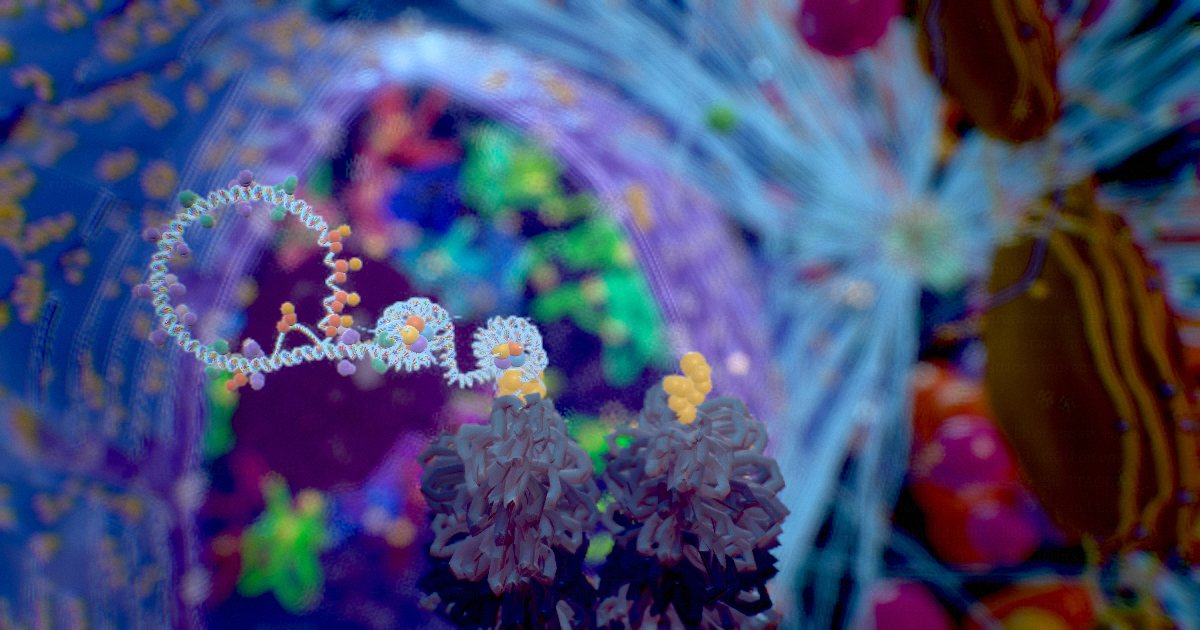
Up close, the tip of a chromosome unwinds into its DNA double helix: nucleosomes first, then the TTAGGG / CCCTAA repeats (each rung is one base pair) folding back into a T-loop, held shut by shelterin. It is drawn about 18× larger than the chromosome behind it, and much shortened: some 90 repeats stand in for the real 800–2,500, and a real T-loop spans thousands of base pairs.
Every chromosome ends in some 5–15 kb of one six-letter DNA word repeated 800–2,500 times: TTAGGG on one strand, paired with CCCTAA on the other. The TTAGGG strand runs on alone for its last 50–300 bases, and this overhang tucks back into the double helix, displacing one strand (a D-loop), to close the T-loop. Shelterin’s six proteins (TRF1, TRF2, RAP1, TIN2, TPP1 and POT1) coat it all, so the cell never mistakes a natural end for broken DNA; TRF2 is the one that folds the loop.
The copying machinery cannot reach the very tip, so telomeres shorten a little with every division. When they get too short, the cell stops dividing. Stem cells and most cancers use the enzyme telomerase to rebuild them.
- Repeat
- TTAGGG · CCCTAA
- Length
- ≈ 5–15 kb
- Per cell
- 92 (184 once copied)
- Lost per division
- ≈ 50–200 bp
Did you know?
Elizabeth Blackburn, Carol Greider and Jack Szostak shared the 2009 Nobel Prize in Physiology or Medicine for discovering how telomeres and telomerase protect chromosomes.
Sources
- Crystal structure of the nucleosome core particle at 2.8 Å resolution · Luger et al. 1997 · Nature
- Telomerase Regulation from Beginning to the End · MacNeil et al. 2016 · Genes (Basel)
- Mammalian Telomeres End in a Large Duplex Loop · Griffith et al. 1999 · Cell
- Shelterin: the protein complex that shapes and safeguards human telomeres · de Lange 2005 · Genes Dev.
- Super-resolution fluorescence imaging of telomeres reveals TRF2-dependent T-loop formation · Doksani et al. 2013 · Cell
- A highly conserved repetitive DNA sequence, (TTAGGG)n, present at the telomeres of human chromosomes · Moyzis et al. 1988 · Proc Natl Acad Sci U S A
- Telomeres in Plants and Humans: Not So Different, Not So Similar · Procházková Schrumpfová et al. 2019 · Cells
- In vivo stoichiometry of shelterin components · Takai et al. 2010 · J Biol Chem
- Dynamics of telomeres and promyelocytic leukemia nuclear bodies in a telomerase-negative human cell line · Jegou et al. 2009 · Mol Biol Cell
- Telomeres shorten during ageing of human fibroblasts · Harley et al. 1990 · Nature
- Extension of Life-Span by Introduction of Telomerase into Normal Human Cells · Bodnar et al. 1998 · Science
- Role of Telomeres and Telomerase in Aging and Cancer · Shay 2016 · Cancer Discov
- Telomeres, stem cells, senescence, and cancer · Sharpless & DePinho 2004 · J Clin Invest
- How many chromosomes do people have? · MedlinePlus Genetics (NIH)
- The Nobel Prize in Physiology or Medicine 2009 · NobelPrize.org