Cytoskeleton · rope-like fibres
Intermediate filaments
Steel cables
In view
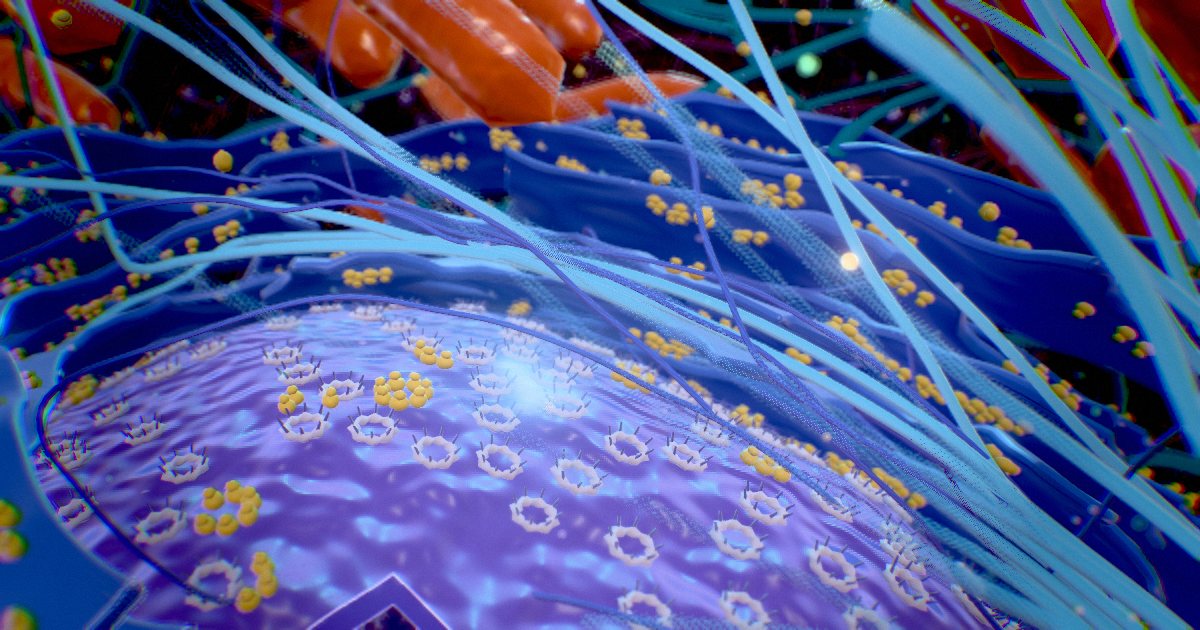
From a loose cage around the nucleus, cables run out to the membrane and bundle into a network that takes up the slack as the cell deforms.
Rope-like fibres about 10 nm across that give cells tensile strength. Unlike microtubules and actin, they do not drive movement; they absorb stress.
Keratins toughen skin cells, vimentin supports connective tissue, and lamins line the inside of the nucleus.
- Diameter
- 8–10 nm
- Human genes
- ≈ 70 (54 keratins)
- Stretch
- up to 3.6× length
- Lamins
- Line the nucleus
Did you know?
A single intermediate filament can be stretched to more than three times its length without breaking, far beyond what actin or microtubules survive.
Sources
- Intermediate filaments: from cell architecture to nanomechanics · Herrmann et al. 2007 · Nat Rev Mol Cell Biol
- Vimentin protects cells against nuclear rupture and DNA damage during migration · Patteson et al. 2019 · J Cell Biol
- 4.5 The Cytoskeleton · OpenStax · Biology 2e
- New consensus nomenclature for mammalian keratins · Schweizer et al. 2006 · J Cell Biol
- The Human Intermediate Filament Database: comprehensive information on a gene family involved in many human diseases · Szeverenyi et al. 2008 · Hum. Mutat.
- Exploring the Mechanical Behavior of Single Intermediate Filaments · Kreplak et al. 2005 · Journal of Molecular Biology