Nuclear body · no membrane
Nucleolus
The ribosome factory
In view
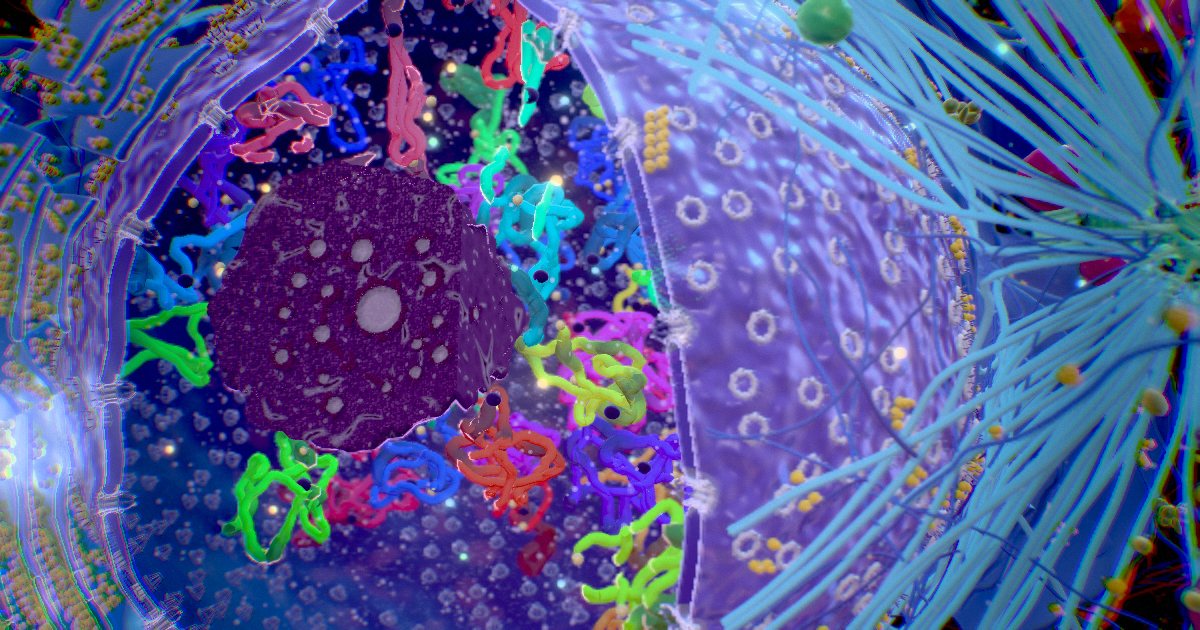
The cut face shows its three layers: pale fibrillar centres, each in a dark, dense shell, set in the granular zone. Yellow sparks are ribosome subunits leaving the nucleolus. They drift to the nuclear pores and exit into the cytoplasm to go to work.
The densest spot in the nucleus has no membrane at all. It is a liquid-like droplet that condenses around the genes for ribosomal RNA, which sit on chromosomes 13, 14, 15, 21 and 22.
Inside, rRNA genes are read at the edge of small, pale fibrillar centres, the RNA is trimmed in the dense fibrillar shell around each one, and the two halves of new ribosomes are finished in the granular zone outside.
- Membrane
- None (a condensate)
- rRNA genes
- ≈ 300 copies
- Output (HeLa)
- ≈ 7,500 subunits/min
- Chromosomes
- 13, 14, 15, 21, 22
Did you know?
Nucleoli behave like oil drops in vinegar: they can fuse and drip. That is why biologists now call them biomolecular condensates.
Sources
- Nucleolar organizer regions: genomic 'dark matter' requiring illumination · McStay 2016 · Genes Dev
- Nascent pre-rRNA sorting via phase separation drives the assembly of dense fibrillar components in the human nucleolus · Yao et al. 2019 · Mol Cell
- Kinetic analysis of translocation through nuclear pore complexes · Ribbeck & Görlich 2001 · EMBO J
- The nucleolus as a multiphase liquid condensate · Lafontaine et al. 2020 · Nat Rev Mol Cell Biol
- Rate of ribosome synthesis in HeLa cell · BioNumbers · BNID 103187