Genome · 46 DNA molecules
Chromosomes
The genome, packed to travel
In view
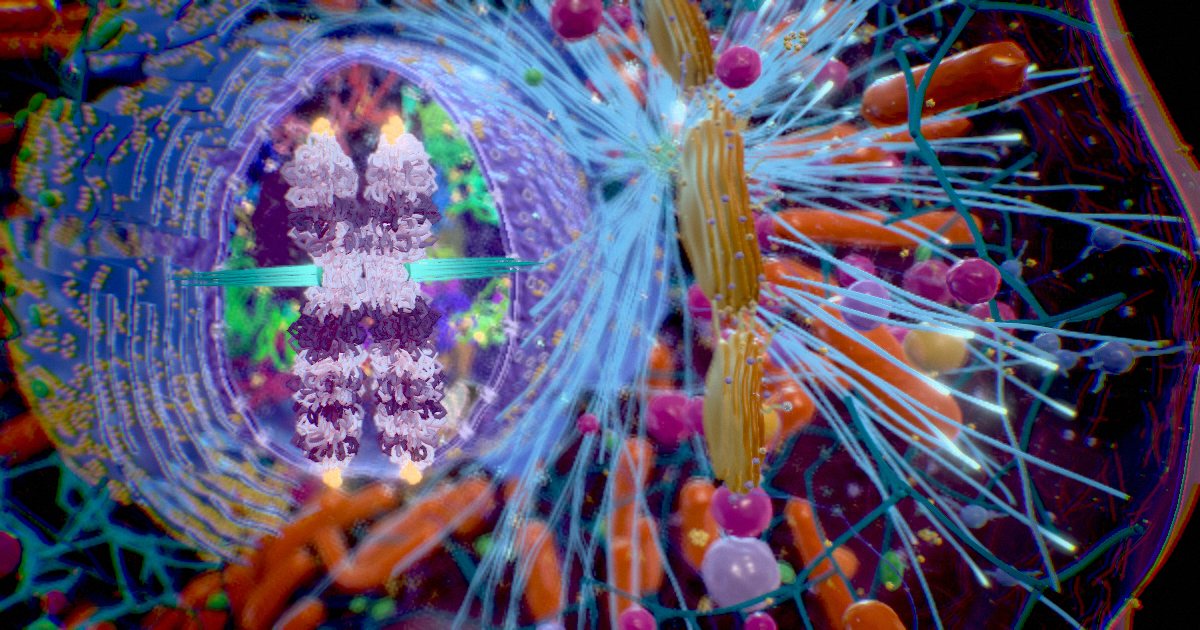
The coloured threads in the nucleus are chromosomes in their working, unwound state, one colour per pair. In front, shown on its own, is one of this female (XX) cell’s two X chromosomes as it looks at metaphase, with chromosome X’s real G-bands. In a real dividing cell all 46 condense together inside the nucleus, the nuclear envelope breaks down, and spindle fibres from two opposite poles grab each one at its kinetochores.
Your genome is split into 46 chromosomes: 22 matching pairs plus two sex chromosomes (XX or XY). Each one is a single, enormously long DNA molecule wound around histone proteins.
Between divisions they stay unwound as chromatin, each filling its own territory in the nucleus. Before a cell divides, every chromosome copies itself and condenses 10,000- to 20,000-fold into two identical sister chromatids side by side, joined most tightly at the centromere (spread on a slide, they splay into the familiar X). Inside, the DNA, still on its nucleosomes, is folded into loops gathered round a core of condensin proteins.
- Number
- 46 (23 pairs)
- Largest
- chr 1 · ≈ 249 million bp
- Smallest
- chr 21 · ≈ 47 million bp
- Compaction
- 10,000–20,000× at division
Did you know?
Chromosome 21 is the smallest human chromosome. An extra copy of it causes Down syndrome, the most common chromosomal condition diagnosed in the United States.
Sources
- Chromosome territories · Cremer & Cremer 2010 · Cold Spring Harb Perspect Biol
- Chromosomes Fact Sheet · NHGRI (NIH)
- Mitosis · Alberts et al. 2002 · Molecular Biology of the Cell, 4th ed.
- Cytogenetic bands of human chromosome X (GRCh38/hg38) · UCSC Genome Browser · hg38 cytoBand track
- How many chromosomes do people have? · MedlinePlus Genetics (NIH)
- Mitotic chromosome scaffold structure: new approaches to an old controversy · Belmont 2002 · Proc Natl Acad Sci U S A
- A pathway for mitotic chromosome formation · Gibcus et al. 2018 · Science
- Human Genome Assembly GRCh38.p14 · Genome Reference Consortium · NCBI
- Down Syndrome · CDC