Cytoskeleton · hollow tubes
Microtubules
Highways and scaffolding
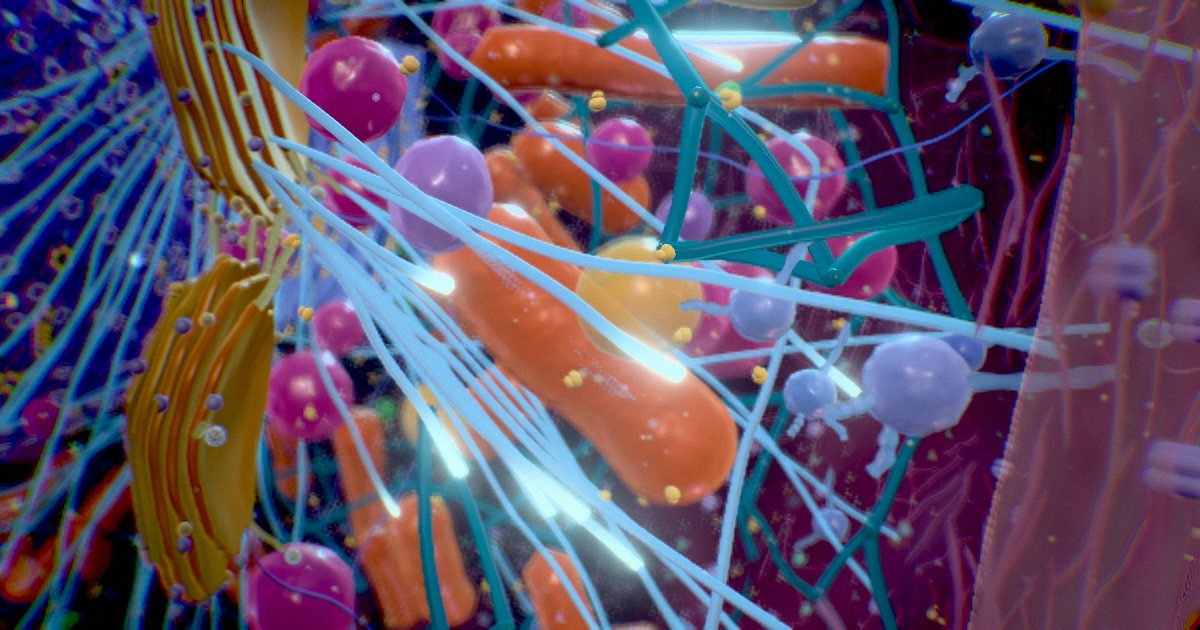
In view
Glowing tips mark growing plus ends. Some tubes race outward, then shrink back abruptly.
Hollow tubes 25 nm wide, built from 13 strands of tubulin. Most minus ends are anchored at the centrosome and many others at the Golgi, while their plus ends grow out toward the membrane, then suddenly collapse and regrow. This search strategy is called dynamic instability.
They are the rails for motor proteins, and during division they form the spindle that pulls chromosomes apart.
- Diameter
- 25 nm
- Protofilaments
- 13
- Growth
- 12–20 µm/min
- Collapse
- 20–32 µm/min
Did you know?
Dynamic instability was discovered in 1984 by Tim Mitchison and Marc Kirschner. The tubes are also stiff: bending them takes hundreds of times more effort than bending actin.
Sources
- Dynamic instability of microtubule growth · Mitchison & Kirschner 1984 · Nature
- Observation and quantification of individual microtubule behavior in vivo: microtubule dynamics are cell-type specific · Shelden & Wadsworth 1993 · J Cell Biol
- How big are the cell’s filaments? · Milo & Phillips · Cell Biology by the Numbers
- The Golgi and the centrosome: building a functional partnership · Sütterlin & Colanzi 2010 · J Cell Biol
- Asymmetric CLASP-dependent nucleation of noncentrosomal microtubules at the trans-Golgi network · Efimov et al. 2007 · Dev Cell
- Molecular Motors: Strategies to Get Along · Mallik & Gross 2004 · Current Biology
- 4.5 The Cytoskeleton · OpenStax · Biology 2e